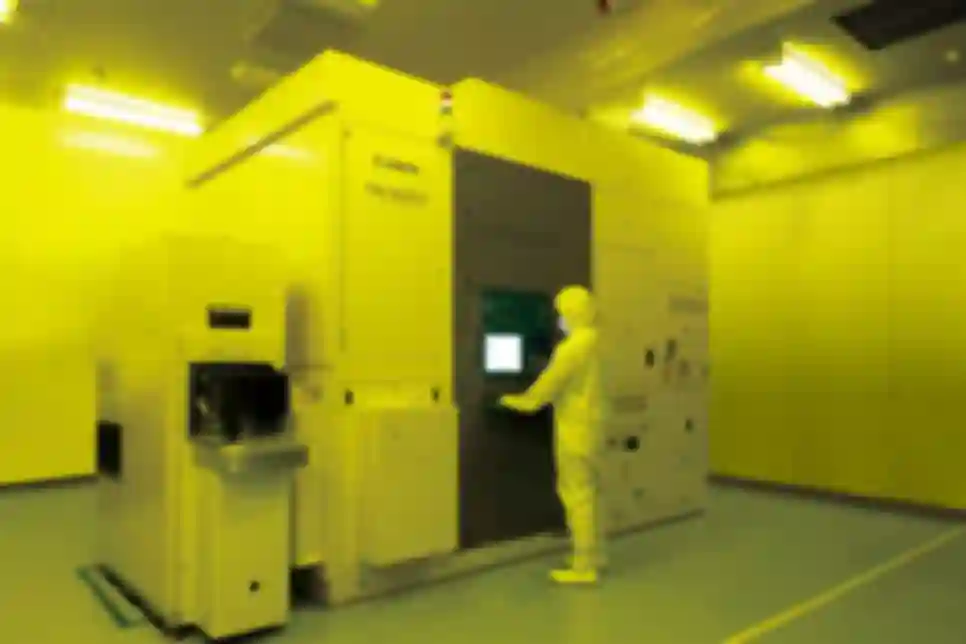
Canon shipped its brand-new lithography system for chip manufacturing to a Texas-based semiconductor consortium. The vendor aims to take market share from leader ASML by simplifying the most expensive step in chipmaking.
The system enables patterns with a minimum line width of 14nm, equivalent to the 5nm node process required to produce the most advanced logic semiconductors currently available, Canon said in a statement. The first nanoimprint lithography (NIL) machine was scheduled to be sent to the Texas Institute for Electronics, which will use it for the R&D of advanced semiconductors and production of prototypes.
Canon explained traditional photolithography equipment transfers a circuit pattern by projecting it onto the resin applied to the wafer to burn a circuit, while the NIL approach involves stamping a mold of the design into it. The Japan-based company unveiled the machine in 2023, promoting a simplified process and lower cost of chipmaking by stamping designs rather than burning using ultraviolet light.
The United Kingdom Atomic Energy Authority (UKAEA) and the Princeton Plasma Physics Laboratory (PPPL) have agreed to link their respective supercomputing platforms to accelerate the development of fusion energy through the use of AI.
Xiaomi has introduced its new Xring O3 smartphone processor, a move that highlights the Chinese manufacturer’s continued efforts to decrease its dependence on third-party chip suppliers.