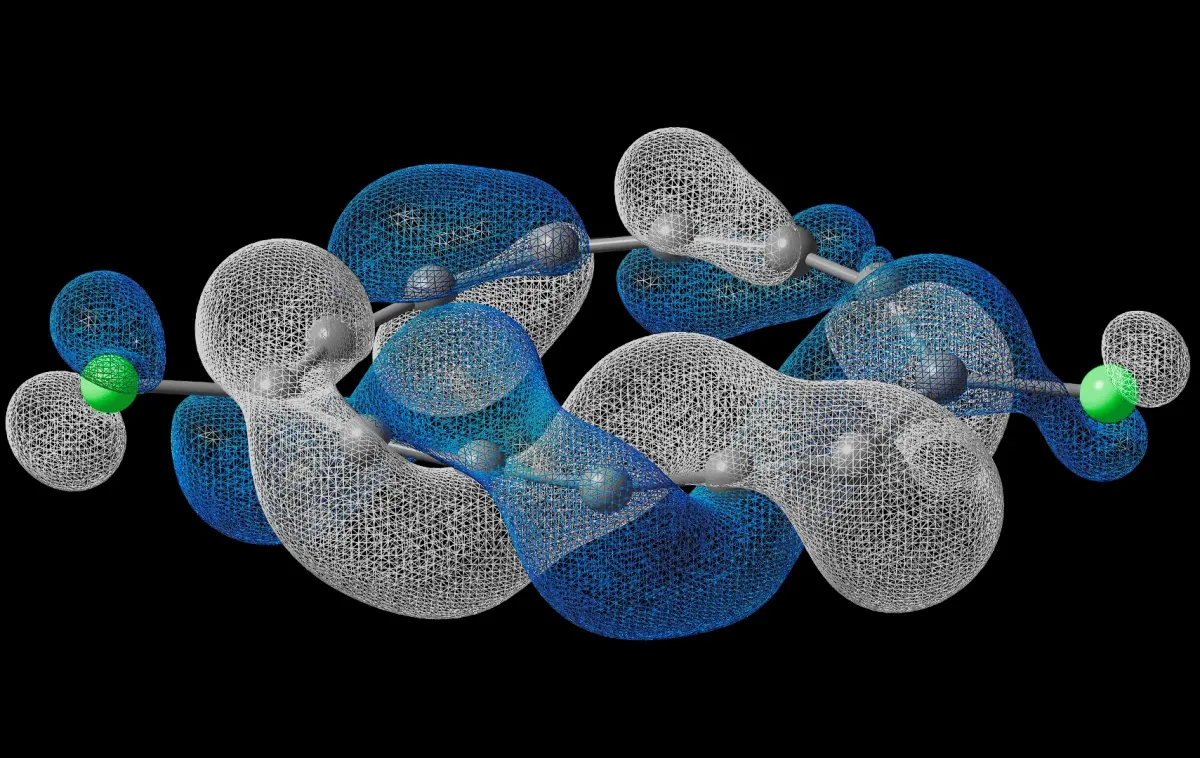
An international team of scientists from IBM, the University of Manchester, Oxford University, ETH Zurich, EPFL, and the University of Regensburg has created and characterized a molecule unlike any previously known. Its electrons travel through its structure in a corkscrew-like pattern that fundamentally alters its chemical behavior.
It is the first experimental observation of a half-Möbius electronic topology in a single molecule. To the scientists’ knowledge, a molecule with such topology has never before been synthesized, observed, or even formally predicted. Understanding this molecule’s behavior at the electronic structure level required something equally fundamental: a high-fidelity quantum computing simulation.
The discovery advances science on two fronts. For chemistry, it demonstrates that electronic topology - the property governing how electrons move through a molecule — can be deliberately engineered, not merely found in nature. For quantum computing, it is a concrete demonstration of a quantum simulation doing what it was designed to do: representing quantum mechanical behavior directly, at the molecular scale, to produce scientific insight that would otherwise have remained out of reach.
“First, we designed a molecule we thought could be created, then we built it, and then we validated it and its exotic properties with a quantum computer,” said Alessandro Curioni, IBM Fellow, Vice President, Europe and Africa, and Director of IBM Research Zurich. “This is a leap towards the dream laid out by renowned physicist Richard Feynman decades ago to build a computer that can best simulate quantum physics and a demonstration where, as he said, ‘There’s plenty of room at the bottom.’ The success of this research signals a step towards this vision, opening the door for new ways to explore our world and the matter within it.”
The molecule, with the formula C₁₃Cl₂, was assembled atom-by-atom at IBM from a custom precursor synthesized at Oxford University, with individual atoms removed one at a time using precisely calibrated voltage pulses under ultra-high vacuum at near-absolute-zero temperatures. Experiments with scanning tunneling and atomic force microscopy, both techniques pioneered at IBM, combined with quantum computing to reveal an electronic configuration with no counterpart in chemistry's existing record: an electronic structure that undergoes a 90-degree twist with each circuit, requiring four complete loops to return to the starting phase.
This half-Möbius topology is qualitatively distinct from any previously known molecule and can be reversibly switched between clockwise-twisted, counterclockwise-twisted, and untwisted states. This demonstrates that electronic topology is not a property to be discovered, but one that can now be deliberately engineered under specific conditions.
The scientists in this experiment created a molecule that had never existed. Now they had to figure out why it worked, a task which challenged conventional computers. The electrons within C₁₃Cl₂ interact in deeply entangled ways, each influencing all the others simultaneously. Modeling that behavior requires tracking every possible configuration of those interactions at once, requiring computational demands that grow exponentially and can quickly overwhelm classical machines.
Using an IBM quantum computer in this workflow, the team identified helical molecular orbitals for electron attachment, a signature of the half-Möbius topology. Moreover, simulation via quantum computing helped reveal the mechanism behind the formation of the unusual topology: a helical pseudo-Jahn-Teller effect.
“The non-trivial topology of this molecule, and the exotic behavior of many other systems, arises from interactions between their electrons. Simulating electrons with classical computers is very hard – a decade ago, we could exactly model 16 electrons, and today we can go up to 18. Quantum computers are naturally well-suited for this problem because their building blocks – qubits – are quantum objects, which mirror electrons. Using IBM’s quantum computer, we were able to explore 32 electrons. However, the most exciting part is that this is just the start. Quantum hardware is advancing rapidly, and the future is quantum,” says Igor Rončević, paper co-author, Lecturer in Computational and Theoretical Chemistry at Manchester University.