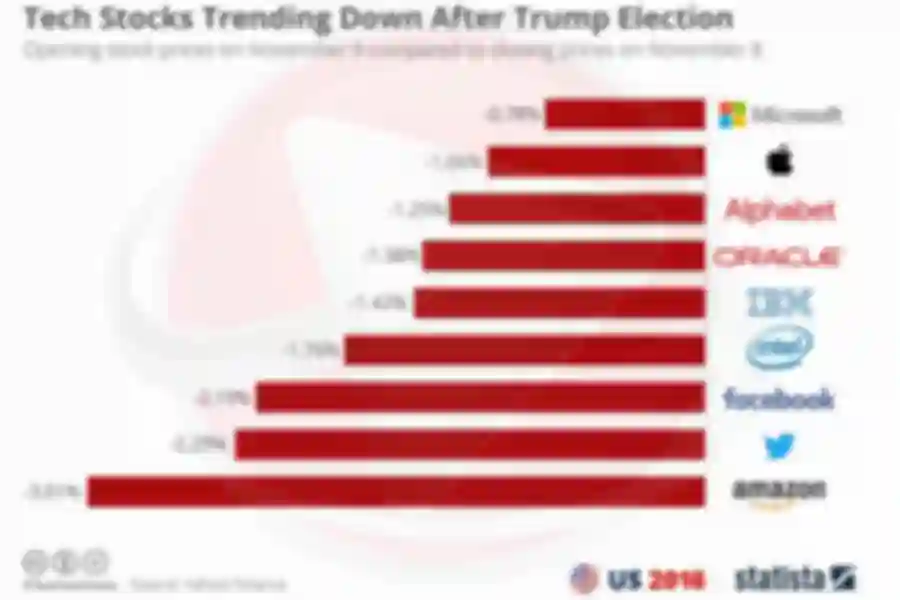
The first impression on the stock market after the newly elected president was in the red. Contrary to most pre-election polls, Donald Trump has beaten Hillary Clinton in the U.S. presidential election and will become the next President of the United States. While Trump’s supporters celebrated the surprise victory, others expressed their fears of what a Trump presidency might entail both politically and economically. As the political situation is now cooling down, and the stock is trading in this trend, but the first day was a turmoil for the tech stocks.
The tech industry was one of the sectors that were most clearly outspoken against Donald Trump during the long campaign, with many companies openly endorsing his Democratic opponent Hillary Clinton. Trump’s protectionist tendencies and plans of revisiting long-standing trade agreements could significantly hurt companies such as Apple who largely rely on Asian suppliers and manufacturing partners.
When the stock market opened several hours after the result was officially called on Wednesday morning, the initial market reaction to Trump’s surprising win wasn’t as severe as many had expected. While most major tech stocks had fallen below yesterday’s closing prices when the market officially opened, the crash that many had feared in case of a Trump victory failed to materialize.
The US International Trade Commission (ITC) has initiated a formal investigation into Apple, Samsung, and Google regarding allegations that the companies have utilized patented audio technology without authorization.
SES has outlined strategic plans to establish direct-to-device (D2D) satellite manufacturing capabilities and a specialized supply chain within Europe in partnership with Elveo Mobile.
Automated systems and bots now generate more than half of internet traffic, forcing hosting companies to manage performance, security, and infrastructure costs at the same time. Ivan Čačija argues that business users are no longer buying only storage and computing resources, but the availability and performance of their own operations. AI will reshape both data-centre management and infrastructure requirements, while regional providers can compete through local presence, predictable costs and hybrid models. Fastserver sees its partnership with Blackwall as part of a broader shift towards an integrated platform combining infrastructure, security, traffic protection and automation.