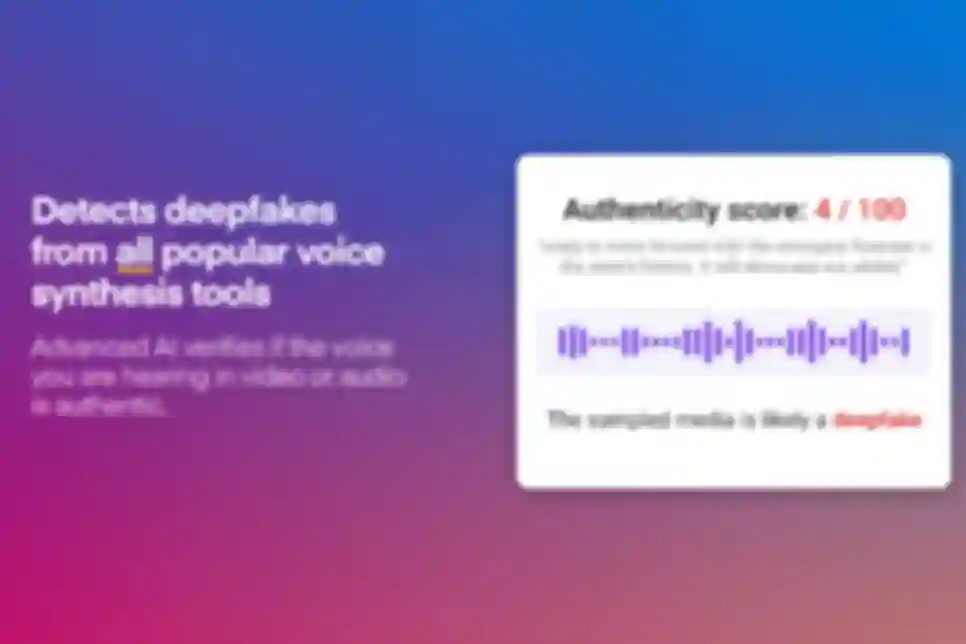
Fraud and spam detection company Hiya rolled out a free Chrome browser extension to identify AI-generated deepfake voices by analyzing the audio. The Deepfake Voice Detector examines voices in video or audio streams and assigns an authenticity score to determine if they are real or fake.
By sampling one second it can determine if the voice is authentic or generated by an AI-based voice cloning tool. It appears to use the company’s AI voice detection technology that it acquired through its acquisition of Loccus.ai in July to determine if the voice is authentic. Hiya president Kush Parikh stated while deepfakes are becoming harder to detect, the company felt it is important to release its detector ahead of the US election in November.
Hiya surveyed 2,000 consumers this year about their exposure to deepfakes and found between April and July one in four people stated they’d been exposed to an audio deepfake. Personal voice calls led the way as the primary risk factor for deepfake calls at 61%. Social media platforms such as Facebook (22%) and YouTube (17%) also ranked high as the top sources of exposure.
Telecom operators approach AI from two directions: as providers of infrastructure for the digital transformation of other industries and as organisations embedding AI into their own processes. A1 Hrvatska has moved from prototypes to concrete products, from customer support to sovereign European cloud services. Daniel Šimić says workforce profiles are also changing, with fast learning, customer understanding and adaptability becoming more important.
Burra was created as a platform for consolidating IT services companies in Southeast Europe, with a commercial focus on Western Europe and the United States. Its first members, Devōt, Tacta and CoreLine, continue to run their existing businesses while integration is planned gradually, primarily through new projects. Sven Marušić says the aim is not to turn founders into corporate employees, but to build a larger organisation in which they remain shareholders and drivers of growth.
Telecom operators are no longer using AI only for network optimisation and routine operations. They are applying it to faster product development and customer conversations. Matija Ražem says AI enables prototypes in hours, quicker market testing, and automation of many standard support questions. The next step may be a world where personal digital agents interact with agents from telecoms, banks and other large organisations.