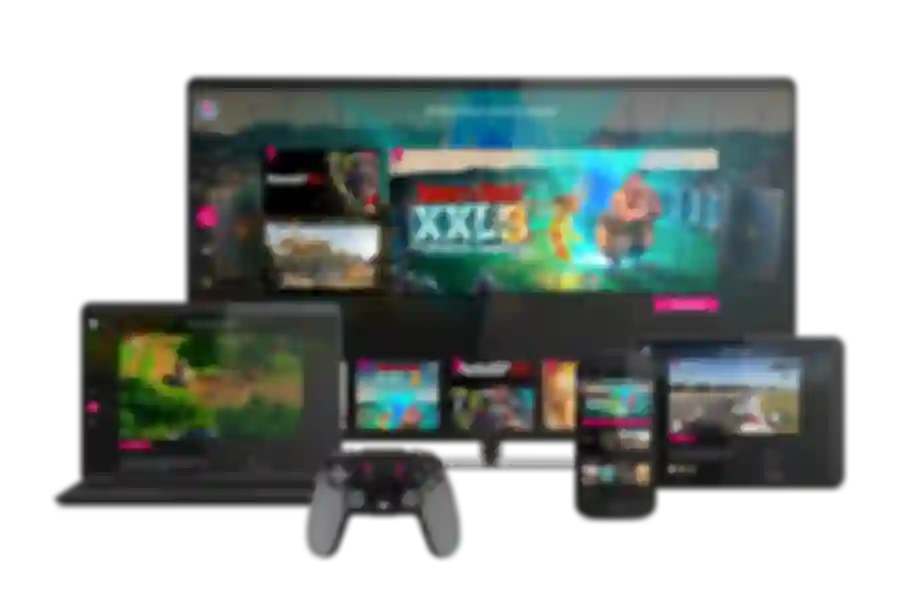
Deutsche Telekom launched a cloud gaming service called MagentaGaming. The company promises low latency and no need for users to buy expensive hardware. The offering is available for customers using Windows PC, Mac and Android devices.
The service starts one year after an initial announcement at gamescom 2019 wit about 100 games available. More than 20,000 users have tested the service extensively in the last year. For the commercial launch, the platform appears in a new design and includes new functions. Scores are stored indefinitely in the cloud, so users can continue their game directly on another device. In addition, several players can play on one screen at the same time.
"The future lies in cloud gaming. Cloud-based technology innovations in combination with our strong Telekom networks, fixed network as well as mobile network, enable a perfectly coordinated end-to-end experience. With MagentaGaming, a large number of interested gamers can now experience high-quality gaming without having to buy expensive equipment beforehand," said Claudia Nemat, DT Board Member for Technology and Innovation.
MagentaGaming uses a decentralised EDGE cloud concept to keep the distance to the customer as short as possible, the company stated. Customers who book the service by 31 October 2020 can use it free of charge for three months. After that, a monthly fee of 6.95 euros will be charged. From August 27 to 30, DT will be present at gamescom as a sponsor with a digital trade fair stand.
AgentOS is Infobip’s response to a phase in which agents are becoming an important tool for process automation and customer communication. Krešo Žmak says the market is still at an early stage, but clients are moving away from AI for the sake of innovation and towards measurable results. The next challenge will be controlling costs, user experience, and the nondeterministic nature of agentic systems.
Telecom operators approach AI from two directions: as providers of infrastructure for the digital transformation of other industries and as organisations embedding AI into their own processes. A1 Hrvatska has moved from prototypes to concrete products, from customer support to sovereign European cloud services. Daniel Šimić says workforce profiles are also changing, with fast learning, customer understanding and adaptability becoming more important.
Burra was created as a platform for consolidating IT services companies in Southeast Europe, with a commercial focus on Western Europe and the United States. Its first members, Devōt, Tacta and CoreLine, continue to run their existing businesses while integration is planned gradually, primarily through new projects. Sven Marušić says the aim is not to turn founders into corporate employees, but to build a larger organisation in which they remain shareholders and drivers of growth.